 |
|
EYES on the PRIZE
Our economy is collapsing if not already dead. Business is closing. Everywhere.
This requires education and training, and vitally, secure investment.
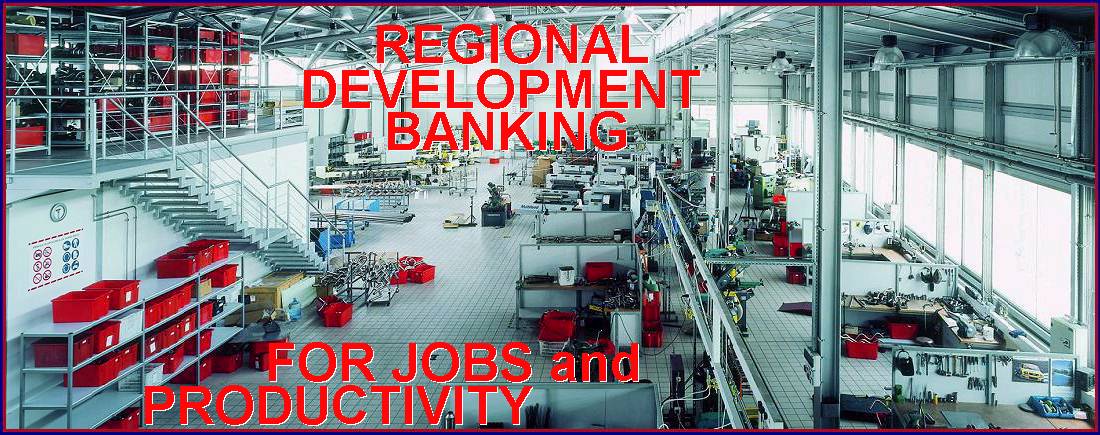
A dedicated Development Banking sector based on Project-Security
|
  |
|
The Formula for National Prosperity is simple: EVERYBODY WORKING EVERYBODY WORKING PRODUCTIVELY Yes it's possible. Here. Right now. And the key, not surprisingly, is money.
Job-creation requires capital:
Traditional bank loans carry no long-term commitment, and private capital can be prohibitively costly.
DEVELOPMENT BANKING avoids these two limitations by securing the investment on the industrial or commercial project itself.
The two broad principles of Development Banking focus on analysis, and commitment.
The Development Bank begins by thoroughly researching each investment proposal from design to production, management and sales, calling on outside expert advice and assistance where necessary. A successful investment recipient will receive full back-up support in a close working and constructive partnership with the Development Bank, both on start-up, then continuously monitored with an ongoing flow of performance data. The Development Bank would levy a fixed charge covering its administrative costs, plus a small insurance premium.
This is not a new idea. Development Banking is alive and well in Germany, France, Singapore, Basque Spain and Canada's Quebec Province, to mention but a few.
With investment risk minimized through proper, pre-investment research and positive on-going monitoring of physical production, sales, and accounting, the business itself becomes the security for its investment.
By setting up Development Banks to operate at regional level, focusing on regional and local needs, investment benefits can be spread widely and uniformly across the nation, avoiding the usual pockets of non- or under-development. Local infrastructure can also be financed.
The total quantity and duration of investment in place and undertaken at any given time must reflect the current state of employment in the economy. Substantial unemployment and spare capacity would indicate longer term investments, with shorter durations as the economy moves towards capacity.
A percentage of the investment charge should also be set aside to fund apprenticeships and on-location training. High youth unemployment is largely caused by the mismatch between the skills that young people offer and those prospective employers need. Indeed, countries with the lowest youth jobless rates have a close relationship between education and work.
Many of today’s successful businesses grew over many years and a long hard climb, starting with minimal capital, operating on a shoestring, and reinvesting every penny of profit. Regional Development Banking can provide sufficient capital for a good business venture to start at full operation, properly equipped for maximum productivity.
By conditionally requiring the highest standards of product and service quality, Development Banking can increase competitiveness, and the high level of productivity which creates real and lasting prosperity.
Regional Development Banks can create jobs and industries NOW, with the guaranteed longterm finance needed to maximize productivity and most importantly, maximize quality.
|
 |
|
The Rich are getting richer, the Poor are getting poorer. Gross and growing inequality of income has become a major issue, and a major source of social discontent. And statistics support popular instincts: the richest 1% of the world’s population now owns 50% of its total wealth, according to a report by Credit Suisse. Is inequality a problem? No, not if it is a fair and accurate reward for hard work, training and education, acceptance of responsibility, and simple success at what you do. But the REAL, the news-making inequality resulting, not from genuine productive work but from financial manipulation, that is arguably one of the greatest injustices of our time.
Simply stated, there is no just and fair relationship between work and reward.
What IS a Fair Day’s Pay? A difficult and contentious issue, one might think, fraught with disputes, frustration and strikes. Actually, no. In fact a solution already exists, and needs only to be applied on a standardized national scale in order to bring stability, and social justice, that essential pre-condition of stability, to the economy.
Formal job evaluation began in the United States with the Civil Service Commission in 1871. As organizations became larger and more bureaucratized the need for a rational system of pay differentials became evident.
It is now commonplace for government agencies, and corporations large and small, to use a system of Job Evaluation to evaluate the work contributed by each staff member. Each job is analyzed, and its essential characteristics and demands such as training, responsibility, working conditions and physical/mental effort involved, are measured on a series of common scales. The job value is then directly related to remuneration. In this way, remuneration is fair, both in relation to the work done, and to the remunerations and work of others.
Currently there are several such systems in use, well tried and working successfully. A single standard could easily be established, a national standard of value for measuring the work element contained in any job, so that remuneration becomes a true reflection of the work involved.
If it is to be fully inclusive, the evaluation process must be applied throughout the income range, from shopfloor to boardroom. A contentious issue no doubt, when it reaches ‘the top’. But Management which actually manages, keeps a longterm view of the business in perspective, reviews alternative options and products – in short, actually manages, should indeed be rewarded according to the standard scale. But Top Managements and Honorary Board Members who are only there for the lunch... Reward must be related strictly to actual, measurable contribution.
Revolutionary in present terms, no doubt. But society already measures apples and milk; it could hardly get along otherwise. Yet of all the commodities traded every day, work is the most important, and work is the one commodity we don’t measure. And it is the most significant, pervading and affecting the entire economic structure.
|
 |
|
A Fair Day’s Pay – and a Fair Price too?
Work evaluation can ensure fair remuneration. This process must be carried through to prices.
A factory’s, or a business’s total costs consist of three elements. First, the cost of bought-in raw materials and components; second, the direct labour added in the factory; and third, the costs of capital write-off, overheads and finance. These are the costs of making a product, of supplying a service. From these costs a Unit Production Cost can be calculated for each product or service supplied. If this Unit Production Cost then becomes the Selling Price, there would be a direct relationship between cost and price, and therefore between pay and purchasing power.
But the Unit Production Cost is not normally equated with the Selling Price. The difference between the two is commonly referred to as the net profit. How is the net profit currently disposed of?
The prior destination for profits has traditionally been the investors, or shareholders, who provide the necessary investment. The other major destination for the disposal of company profit is re-investment, either in research and equipment or increased working capital. The advantage is that in-house or self-generated investment comes without future servicing cost or commitment to repay.
Business, particularly physical production, is continuously re-inventing itself, as research and on-site improvements, spurred by competition, develop new ways of making products better and cheaper. As productivity increases and products become cheaper to make, there should be some gain to society in the form of lower prices. But it is not only the customer who benefits from lower prices, the producer benefits too, as lower prices are reflected in increased sales.
In 1913 Henry Ford introduced the continuously moving assembly line. This move dramatically reduced production costs, which Ford astutely passed on in a corresponding price reduction. This not only increased sales, but left the competition way behind. The effect of simplification and scale was to move the price of a Model T down to $550 by 1914, when 248,30 were sold. By 1917, the price had been reduced even further, to $360, with the result that sales soared to 785,432. In 1920, Ford sold 1.25 million Model T's.
Lower costs, lower prices, increased sales, resulting in further productivity gains... a virtuous circle.
Pay, Profit and Price Evaluation: a fair wage, a fair price.
|
 |
|
The essential ingredients of maximum, nation-wide prosperity are simple and straightforward.
One. Full employment is clearly a primary ingredient of prosperity. If 5% of the working population is unemployed, 5% of productive capacity is wasted. That means maximizing access to education and training, not as charity, but as an investment in our future.
Two. Maximum productivity: everybody working productively. Even if everybody is working, but working inefficiently using outdated equipment with poor organization, then again, output and potential prosperity, will be reduced.
Three. Maximizing productivity requires secure, longterm, committed investment, in education, training, research and development, in the tools and machinery of industry, and in the nation’s infrastructure.
Four. An inclusive, nation-wide, top-to-bottom system of remuneration, price and profit evaluation creates a foundation of true social justice and monetary stability.
A powerful combination which cannot fail to give us the widely shared prosperity of which we are surely capable and which would so enrich all our lives.
And it’s all do-able. Right now.
|

|
Prosperity won. Prosperity lost.
Government is the nation’s biggest spender, taking anything up to 50%-plus of the nation’s earnings. It is also a monopoly, subject to little or no discipline in the efficiency of its operations and its cost-effectiveness. It taxes and spends at will with very little meaningful accountability. We need to establish a new relationship which accurately reflects reality, namely that government is a service to its citizens, its wages paid by its citizens as its customers. The process of government must be clearly defined in its field of action and subject to strict financial and administrative disciplines, so that it fulfills its functions productively without incurring an over-burdensome tax on the nation’s earnings. Good Government at Less Cost - Disciplined and Productive.
|

|

|
|



 |
 |